


How-to guide
How to build a charcuterie board
September 11, 2026
A good board is not a pile of food, it is a layout. Here is the order we arrange ours in, the ratios that keep it balanced, and the finishing touches people notice without ever being able to name them.
Jump to the steps
Nobody has ever complained that a board had too much cheese on it. What guests notice, without being able to name it, is the arrangement: whether the colors are spread out, whether every bite has a partner within reach, whether the board looks full to the edges or thin in the middle.
We arrange tens of thousands of boards a year and the order never changes. Big items first, small items last, gaps filled at the end. Work in that order and a board that took 25 minutes looks like it took two hours.
What you will need
Six categories, nothing more. Buy one good example of each instead of three mediocre ones, and plan on two ounces of cheese and two ounces of meat per person for an appetizer.
- The board12 by 16 inches feeds six as an appetizer. Raised lip if you have one.
- 3 to 5 cheesesOne soft, one semi firm, one hard and aged, one blue if the crowd will eat it.
- 3 to 4 cured meatsProsciutto, soppressata, capicola and a salami covers every palate at the table.
- Something sweetFig jam, honeycomb, dried apricots, fresh grapes. One jarred, one fresh.
- Something crunchyMarcona almonds, candied pecans, seeded crackers served on the side.
- Something brinyCastelvetrano olives, cornichons, a grainy mustard to cut the fat.
Choose the board
Size the board to the guest count before you buy a single piece of cheese. A 12 by 16 inch board feeds six people comfortably as an appetizer. Anything smaller and you end up stacking, which is the fastest way to make an expensive spread look cheap.
Wood, slate and marble all work. What matters more than the material is the edge. A board with a raised lip keeps olives, nuts and cornichons from rolling onto the table every time somebody reaches across it.
Anchor the cheeses first
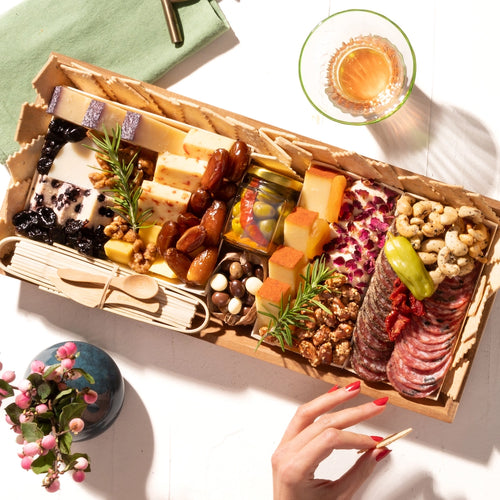
Cheese goes down before anything else, and it goes down spread out. Place one near each corner and one toward the middle so no quarter of the board is left without an anchor. Everything you add after this fills in around them.
Pick for contrast rather than for variety alone: one soft (brie or chevre), one semi firm (manchego or gouda), one hard and aged (parmigiano or a sharp cheddar), and a blue if the crowd will eat it. Pre cut the hard cheeses into planks or cubes. Leave the soft ones whole with their own knife, because the first person to serve themselves sets the standard for everyone after.

Fold the meats for height
Flat slices read as flat. Fold prosciutto into loose ribbons so air sits inside the fold, fan salami into a river running between two cheeses, and quarter the wider rounds so they shingle instead of lying down.
Height is the whole trick. A board built entirely at one level looks like a tray. A board with two or three heights looks arranged, and it photographs far better under a kitchen light.
Fill every gap
Now the small things. Nuts, olives, dried apricots, cornichons, a small cluster of grapes, a spoonful of fig jam. Work them into the spaces between the cheeses and the meats until you cannot see the board through the food.
Anything wet belongs in a small bowl set directly on the board. Honey, jam, mustard and marinated olives will bleed into a cracker within minutes, and a bowl also buys you another level of height for free.
Garnish, then rest before serving
Finish with the things nobody eats first: rosemary sprigs tucked along an edge, a wedge of honeycomb, figs halved so the inside shows. Three or four garnishes is plenty. Past that it starts to look like a centerpiece instead of food.
Then leave it alone. Pull the board out of the refrigerator 30 to 45 minutes before guests arrive. Cold cheese tastes like almost nothing, and that rest is the single easiest upgrade on this entire list.

Pro tips
-
Work in odd numbers
Three cheeses look composed. Four look counted. Odd groupings read as deliberate even when they are not.
-
Repeat colors diagonally
Put the apricots in one corner and the honeycomb in the opposite one. The eye follows the repeat across the board.
-
Crackers go beside, not on
A cracker resting against soft cheese is soft itself in 20 minutes. Serve them in a bowl or in a fan alongside.
-
Budget two ounces each
Two ounces of cheese and two ounces of meat per person for an appetizer. Double both if the board is dinner.
Or skip the build entirely
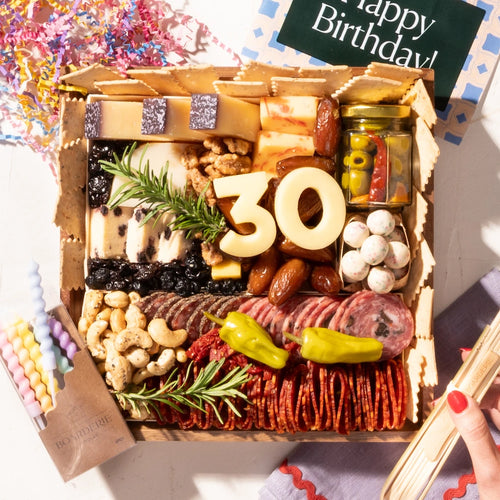
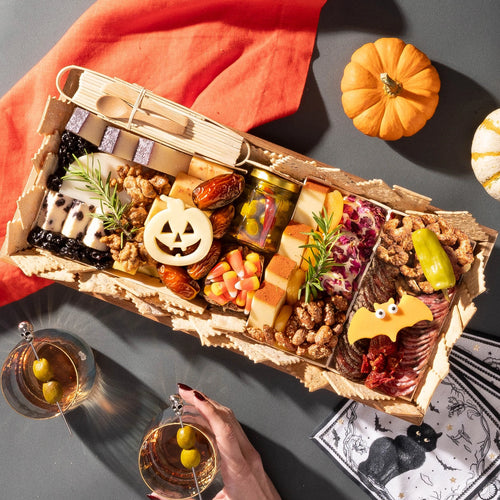
Our boards arrive fully arranged in a refrigerated box, with the cheeses anchored, the meats folded and every gap already filled. You lift the lid and set it on the table. No prep, no plating, nothing.
Shop the boardsCommon questions
How far in advance can I build a charcuterie board?
How much cheese and meat do I need per person?
What cheeses should go on a charcuterie board?
Do crackers belong on the board itself?
How long can a charcuterie board sit out?
What if I would rather not build one at all?
Keep reading
All charcuterie guides
Charcuterie Board Layout 101: Anatomy and Placement Tips
The structural rules behind a board that looks composed instead of crowded.

Charcuterie Board Pairings: Wine, Crackers and Beyond
What to pour and what to serve alongside so every bite has a partner.

Common Charcuterie Mistakes and How to Avoid Them
The seven habits that quietly flatten a board, and the fix for each one.
