
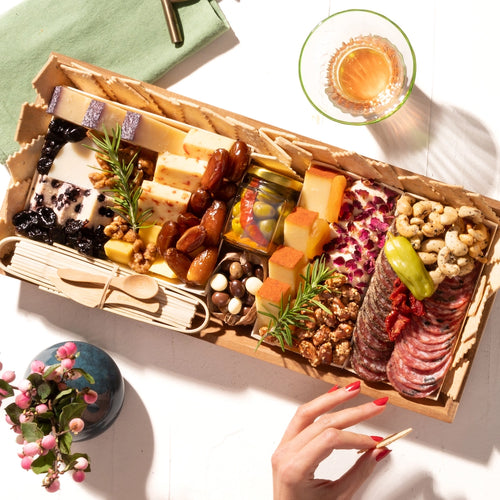
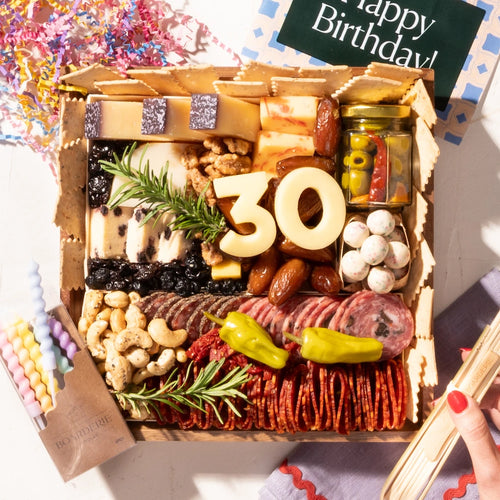
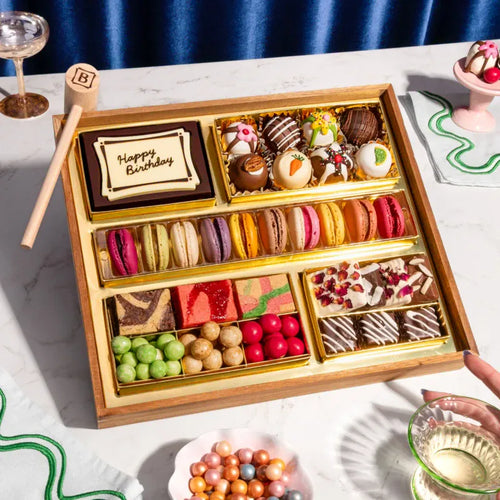
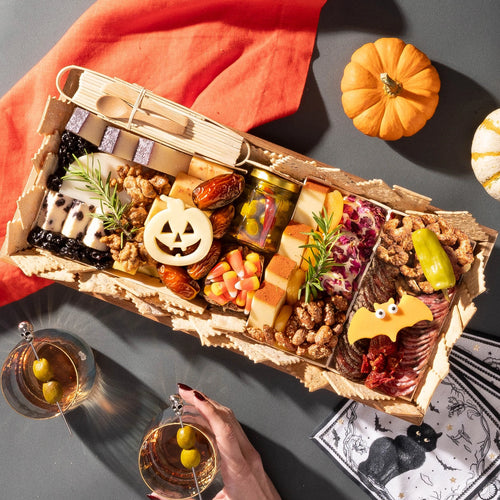


There's a moment most of us have experienced in the last few years: you're scrolling through Instagram or TikTok, and a perfectly arranged board of prosciutto roses, honeycomb, aged cheddar, and marcona almonds stops your thumb mid-swipe. It looks almost too beautiful to eat. And then someone in the comments asks, "Where can I order one of these as a gift?" That question sits at the center of one of the most significant shifts in gourmet gifting in a generation. Charcuterie boards have become the default gift for people who want to send something that feels personal, looks stunning, and actually gets eaten. Google search interest in charcuterie has surged more than 800% over the past five years, and the category shows no sign of cooling. But the real story is about why charcuterie landed at the exact intersection of several powerful cultural currents, and why it's reshaping what we expect a "great gift" to look like. Understanding those currents matters whether you're a consumer trying to figure out why everyone suddenly wants a cheese board for their birthday, or a brand trying to make sense of a category that barely existed at scale a decade ago.
The Pandemic Lit the Fuse But Didn't Create the Spark
It would be easy to credit COVID-19 with the entire charcuterie boom, but the timeline is more nuanced than that. Charcuterie boards were already gaining traction on social media before March 2020, particularly among food bloggers and millennial home entertainers who'd discovered that a well-styled board could make a Tuesday night feel like an event. What the pandemic did was pour accelerant on that existing spark.
Pre-packed charcuterie saw an 80% volume increase in Q2 2020 compared to the prior year. Even after the initial wave of pandemic stockpiling passed, volumes remained roughly 40% above 2019 levels. People stuck at home rediscovered the appeal of assembling and sharing food with the small group in their bubble, and the charcuterie board became the centerpiece of that ritual.

But here's what separates charcuterie from other pandemic food trends like sourdough bread or dalgona coffee. It didn't fade when the world reopened. Those other trends required effort, novelty, and boredom to sustain them. Charcuterie didn't, because it was never really about killing time. It was about creating a moment of connection around food, something that remained equally relevant when dinner parties and office gatherings resumed. Charcuterie made its annual "What's Hot" culinary list for 2023, well after pandemic restrictions had lifted, confirming that the category had crossed from fad into fixture.
The staying power also comes from sheer versatility. 30% of consumers who make charcuterie boards at home use them as protein-packed snacks, while 31% serve them as no-cook dinners. The format has expanded into brunch boards, dessert boards, and even "seacuterie," seafood, forward arrangements featuring smoked salmon, shrimp, and tinned fish. When a food format can serve as an appetizer, a meal, a snack, and a gift, it's a category.
Social Media Turned Cheese and Meat Into Visual Currency
The charcuterie board is one of the most photogenic foods in existence. A well-composed board offers color contrast, texture variety, geometric patterns, and the kind of abundant overflow that performs exceptionally well on visual platforms. It's why the format exploded on Instagram and later TikTok in ways that, say, a beautifully braised short rib never could.
The hashtag #charcuterieboard has garnered billions of views across social platforms, and the content ecosystem around it has given rise to an entirely new class of creators: cheese board influencers. They're stylists and entertainers who treat board-building as a visual art, posting time-lapse arrangement videos that routinely pull millions of views. The format is perfectly suited to short-form video. The satisfying progression from empty board to abundant spread compresses into 30 to 60 seconds of deeply watchable content.
This visual virality had a direct commercial consequence. When millions of people see stunning charcuterie boards daily, two things happen simultaneously. They want to recreate them and send them to others. The social proof loop is remarkably efficient. Someone receives a beautiful board as a gift, photographs it, posts it, and that post inspires three more people to send one. Companies like Boarderie, which ships pre-assembled, ready-to-graze charcuterie boards overnight nationwide, have built entire businesses on this loop, making it possible for someone who sees a stunning board on their feed to send one to a friend across the country within minutes.
Experiential Gifting Rewrote the Rules and Charcuterie Fit Perfectly
The rise of charcuterie gifting didn't happen in isolation. It arrived alongside a broader generational shift in what people consider a "good" gift. For millennials and Gen Z, the answer increasingly isn't a thing. It's an experience. 78% of Gen Z would rather spend money on experiences than physical goods. Nearly half of all consumers now plan to gift experiences, with Gen Z (68%) and millennials (61%) far outpacing baby boomers (23%). Over 50% of Gen Z luxury consumers prioritize experiences or storytelling over product ownership.
Charcuterie boards sit in a uniquely powerful position within this framework. There's a tangible, physical product being delivered. But they're not a static object that sits on a shelf, either. A charcuterie board is an invitation to gather, to taste, to share. It creates a moment.
This experiential quality solves one of the deepest problems in gifting: the anxiety of getting it wrong. Physical gifts carry the risk of the wrong size, duplicate ownership, clashing tastes, or simple indifference. Gift cards solve the risk problem, but feel impersonal. Charcuterie is specific enough to feel thoughtful, universal enough to work for almost anyone, and self-destructing enough that it never becomes clutter. That combination is rare, and it explains why charcuterie has pulled gift-giving dollars from traditional categories like candles, bath sets, and generic chocolate boxes that have dominated for decades.

Corporate Gifting Discovered What Consumers Already Knew
For years, the category operated in a narrow and largely uninspired band: logo-branded merchandise, generic wine bottles, or gift cards. They checked a box without creating a memory. But as companies increasingly compete for talent retention and client relationships, the bar for what constitutes an acceptable gift has risen sharply, and charcuterie has risen with it.
- Charcuterie Solves Four Gifting Pain Points at Once: Charcuterie boards address several corporate gifting challenges simultaneously. They're universally appealing, eliminating the need to guess individual preferences across a diverse and often geographically distributed recipient list. They're inherently shareable, meaning the gift is often enjoyed with colleagues or family, extending brand impression well beyond a single person. They photograph well, generating organic social posts that function as unpaid endorsements. And because they're perishable, they don't end up in a desk drawer or a donation bin. They get used, experienced, and remembered.
- Logistics Infrastructure Unlocked Corporate Scale: The scalability challenge has been solved by companies like Boarderie, which offers corporate gifting programs for orders of 30 or more boards, complete with customized gift notes and company logo integration. Their boards are crafted fresh daily and shipped overnight, arriving fully assembled and ready to serve. That logistics infrastructure didn't exist five years ago, and its emergence has opened a gifting channel that previously would have been impractical at corporate scale.
- Authenticity Aligns With Evolving Corporate Values: Companies that pride themselves on sustainability, craft, and quality want gifts that reflect those commitments. A board featuring locally sourced cheeses and artisanal accompaniments tells a story. That a fruit basket or a box of truffles simply doesn't. In a business environment where brand values are increasingly public and scrutinized, the gift a company sends is itself a signal worth managing deliberately.
For companies looking to send gifts that land rather than linger, the question is no longer whether charcuterie belongs in the mix. It already does.
Personalization and Dietary Flexibility Sealed the Deal
One of the quieter reasons charcuterie has dominated gifting is its remarkable adaptability to the increasingly fragmented landscape of dietary preferences. In any given group of ten people, you might find keto dieters, vegetarians, gluten-free eaters, dairy enthusiasts, and someone doing Whole30. A traditional gift box alienates half that group. A charcuterie board can accommodate almost everyone.
The format's inherent flexibility is part of its genius. A board can skew heavily toward protein for low-carb recipients, emphasize plant-based elements for vegetarians, or feature gluten-free crackers and accompaniments without fundamentally changing what it is. The 2025 trend landscape has pushed this even further, with vegan charcuterie boards emerging as a legitimate subcategory and "seacuterie" boards offering pescatarian-friendly options featuring smoked salmon, marinated shrimp, and tinned fish, paired with creamy cheeses and crisp breads.
Personalization extends beyond dietary considerations. The gifting market is riding a massive personalization wave. The global personalized gifts market was valued at $40.93 billion in 2022 and is projected to reach $138.17 billion by 2030, growing at nearly 13% annually. Charcuterie naturally lends itself to this trend. Boards can be customized for occasions, for taste preferences, or for scale.
The Quality Revolution That Made It All Possible
A decade ago, the idea of shipping a pre-assembled board of artisan cheeses, cured meats, and fresh accompaniments across the country would have been logistically impractical. The cold chain infrastructure, packaging technology, and overnight shipping networks simply weren't calibrated for that kind of product. Today, companies have solved those problems, so a recipient in Portland can open a box and find a board that looks identical to what they'd see at a high-end catering event in Miami.
The ingredient-quality conversation has also shifted. The 2025 charcuterie landscape emphasizes "cleaner ingredients, smarter choices, and total customization." Consumers are moving away from over-processed deli meats and artificial fillers toward minimally processed, clean-label options where transparency is non-negotiable. For gifting, this matters enormously. Sending someone a board full of ingredients you can pronounce and trace to their source carries a very different emotional weight than a box of mass-produced snacks.
The aesthetic dimension has evolved in parallel. The visual language of charcuterie has become more sophisticated and diverse, moving beyond the classic meat-and-cheese-on-wood arrangement to include themed color palettes and format innovations such as individual grazing boxes designed for single servings. This design evolution keeps the category fresh and gives it the visual novelty that social media platforms reward.

The format will continue to evolve. Breakfast boards, dessert boards, and seacuterie are already expanding the definition of what a "charcuterie gift" can be. Sustainability-forward boards featuring reusable serving ware, organic ingredients, and minimal packaging will appeal to environmentally conscious gift-givers. And the personalization frontier is just beginning to be explored. But the deeper reason charcuterie gifting will endure is simpler than any market projection. In a world that's increasingly digital and increasingly cluttered with stuff nobody needs, a beautiful food board designed to be shared with the people you care about answers a very human craving. It says: gather around this. Slow down. Taste something good together. That's a need that was always there, waiting for the right format to serve it.
Sources:
- Progressive Grocer — Charcuterie Craze: Why the Trend Is Here to Stay
- Progressive Grocer — Inventive Charcuterie Trends Revitalize At-Home Entertaining
- National Restaurant Association — Charcuterie Makes the Cut for 2023
- Midan Marketing — Meat Consumers Join the Charcuterie Trend
- Business Research Insights — Food Gifting Market Size & Growth Forecast 2025-2033
- Specialty Food Association — State of the Specialty Food Industry Report
- American Cheese Society — U.S. Artisan and Specialty Cheese Industry Data
- Tastewise — Charcuterie Board Trends 2025
- Eventbrite — Gen Z Experience Spending Research
- Snappy — 2025 Employee Holiday Gifting Insights
- StorageCafe — Latest Gift Trends: Millennials Choose Experiences
- Data Insights Market — Gift Baskets Industry Overview and Projections
- Taste of Home — Boarderie Charcuterie Board Delivery Review
